
Polyamory vs Open Relationship vs Swinging: A Therapist’s Guide to the Difference
Table of Contents
Sometimes I loooove words, and other times they drive me absolutely insane. The number of times I’ve been asked, “What’s the actual difference between polyamory, open relationships, and swinging?” Or someone brings up SLOWM and asks if that was polyamory vs open relationship vs swinging. And then, depending on the conversation, someone throws relationship anarchy or monogamish into the mix, and things get muddier instead of clearer.
The thing is… I get it. The words have been used interchangeably for years; people use them to mean different things; dating apps slap them on as labels with zero definition; and there’s no shared “playbook” anywhere. So as both a therapist who works with folks across the entire non-monogamy spectrum AND a polyamorous person myself, here’s the breakdown I give people when they sit down to figure out what they actually want.
On one hand, labels matter. They help us feel seen, communicate who we are, belong to a community, among any other things. And on the other hand, labels can feel restricting and cause a lot of anxiety. What really matters is that you’re talking about the same thing. So, just keep that in mind as we go through this.
Oh, and one more thing before we go: none of these structures is more evolved, healthier, or “further along” than the others. They’re different shapes – not better than another – just different.
Quick answer: polyamory vs open relationship
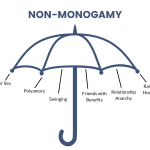
The quick version, so you can save this and come back later – ALL of these are under the umbrella of non-monogamy:
- Polyamory: multiple loving relationships, usually/often with emotional intimacy across more than one partner.
- Open relationships: a primary partnership that ‘allows’ sex (and sometimes connection) with people outside it.
- Swinging: recreational, usually MF couple-centered, sexual experiences with other couples or individuals, often without ongoing emotional involvement.
- Relationship anarchy: a philosophy that rejects automatic hierarchy between romantic and non-romantic relationships.
- Monogamish: mostly monogamous with specific, limited openings.
The differences sit on a spectrum. Most folks I work with end up building their own hybrid version of some of these with their own spice blend. 🙂
The non-monogamy umbrella
Here’s the umbrella term you’ll see most: consensual non-monogamy, ethical non-monogamy, or what we say around here, just non-monogamy. Non-monogamy is any relationship structure where everyone involved has agreed that the relationship is not exclusive in some specific way. Let’s be very clear that cheating is not non-monogamy. Cheating is cheating. You can’t agree to cheating. Non-monogamy is a structure everyone has agreed to, in a specific shape that’s been talked about out loud.
A quick note on what the research actually says about all of this: Dr. Terri Conley’s research has found that non-monogamous relationships are not lower in satisfaction, commitment, or trust than monogamous ones. In some measures, they score equal or higher. It’s a relationship structure for a different set of values than in monogamous relationships, and the data supports that.
What is polyamory?
Polyamory is the practice of having multiple loving, intentional relationships with the knowledge and consent of everyone involved. The word literally means “many loves.” The emphasis is on emotional intimacy across more than one connection, not just sex. (Though no judgment for those who find their emphasis to be on sex… that’s real and valid too!)
This is the structure I live in, so I’m going to get a little more detailed here. Polyamorous folks may have two partners, three, more, or be in a phase where they have one partner and are open to more. The relationships are often long-term and pretty unsexy in their day-to-day lives: calendars, doctor appointments, or squeezing in lunches or co-working coffee dates. Partners frequently meet each other, spend time together, and may co-parent, share homes, or build long-haul lives across multiple connections. This is all VERY dependent on the style or type of polyamory being practiced, and it’s essential to talk to your partner about the type of polyamory you want and ask them about what they want and what their partners want, etc.
You know how a lot of people love the combination of sexy and cute physical appearance? Polyamory is the relationship structure version of sexy + cute — the perfect combo.
In all seriousness though, on a personal note, polyamory allows me to be me and explore what is naturally there between me and someone else honestly and openly. That doesn’t mean anywhere, anyone, all the time — it means I’m almost always open to feel into something. I have my nesting partner, who is also my co-mama, and my wife, who is my rock. We invest in each other and create a foundation of trust, love, care, and so many other things that we try our best to intentionally bring into our home. She’s gorgeous — I get to share a bed with her almost every night and have other deep, meaningful relationships or playful sexy adventures, or both, or none?! I can just be.. me?! Sign me up. Additionally, I have my platonic life partner Amanda and another partner here in NYC.

Dr. Elisabeth Sheff’s 20+-year longitudinal research on polyamorous families is among the most important work in this field. Her findings, published in multiple books and peer-reviewed papers, show that polyamorous family structures can be stable, healthy, and good for kids when the adults do the relational and communicative work the structure requires.
The sub-styles within polyamory you’ll hear most:
Hierarchical polyamory is when folks want a “primary” partner and are explicitly clear about who that partner is. Usually a ‘primary’ partner is the one you live with (aka nesting partner), share finances with, or co-parent with. Secondary or tertiary partners are also valued, but the hierarchy is named and agreed upon so that no one wonders where they stand. Some folks find this structure deeply grounding, while others find the language restrictive or even dehumanizing. The right fit depends on what you and the folks you’re in relationship with actually need.
Non-hierarchical polyamory is for folks who want each relationship to be designed on its own terms, without anyone being formally ranked. This often shows up in practice even when practical realities (who you live with, who you co-parent with) create some de facto differences. You still acknowledge those practical realities. They just don’t get to decide which relationship matters most, or who gets to feel like they’re a footnote. For those with lives built around kids, etc., this may look more like a mindset shift with fewer behavioral changes.
Kitchen table polyamory is a version of poly where you, your partners, and your metamours can sit at the same kitchen table together and feel at ease with each other. (Yes, like a literal kitchen table.) The integration can feel beautiful and chosen-family-ish for everyone involved, and it asks a lot of patience and good faith from the metamours too. It’s a beautiful shape when it fits, and it can also feel like too much for folks who need more separation.
Parallel polyamory is a form of polyamory in which your relationships exist alongside one another without really overlapping at all. Your partners know about each other but don’t necessarily spend time together, and they aren’t asked to be friends. This is the right shape for folks who want a clearer container around each relationship, or whose partners genuinely don’t have the bandwidth for additional social labor.
Again, this is all VERY dependent on the type of polyamory being practiced, and it’s essential to talk to your partner(s) about the type of polyamory you want and ask them about theirs and their partners’, etc. Polyamory tends to fit folks who want depth and continuity across multiple partnerships and are interested in the longer arc of relational work that comes with it.
Personally, I am oriented for kitchen-table poly. That doesn’t necessarily mean I require some sort of weekly polycule/constellation dinner, but it doesn’t mean I’m not available for a don’t-ask, don’t-tell situation, and I don’t want to be some sort of secret. For some people, parallel poly works super well, and I’ve had partners in the past where it’s been more parallel, but it’s not my personal preference.
What is an open relationship?
Open relationships are for folks who want the centrality of a primary partnership AND want to make room for sexual experiences outside it. The two main partners are committed to each other, and they’ve agreed that one or both of them can have sexual connections with other people, in a way that they’ve talked through together. I do want to note that the term ‘open relationship’ is used so often, and, like some other labels, it can mean different things to different people. But here are some key features of most open relationships, since the term is commonly used:
- A clearly defined primary partnership
- Agreements about what’s permitted outside the partnership
- A structure where the primary partnership is explicitly central

“Open” sometimes gets used as a broad umbrella term, the way “non-monogamy” is. When people use it specifically, they usually mean a couple-centered structure with sexual openness.
One framework that helps a lot in all types of open relationships, drawn from Franklin Veaux and Eve Rickert’s More Than Two, is the difference between agreements and rules. Rules try to control your partner’s behavior, while agreements describe what each of you commits to doing. Rules are set for us; agreements are created between us. The shift from rules to agreements is one of the single biggest predictors I’ve seen for whether an open relationship lasts, and it’s worth a serious conversation with your partner before you go any further.
What is swinging?
Let me say something upfront, because swingers get a lot of bad assumptions made about them: the swinger community is actually one of the most organized, communal, and well-defined parts of the non-monogamy world. People dismiss it as superficial or “just sex” and miss that there’s an entire subculture there with its own values, etiquette, and long-haul friendships. If you’ve ever felt judged or made fun of for being swing-curious or swing-active, that judgment is about the culture’s discomfort with pleasure, not about you.
Swinging is for couples who want to bring sexual variety into their relationship together without changing the primary structure. It’s recreational non-monogamy that’s usually couple-centered and focused on sexual experiences with other couples or individuals, often in social settings like parties, clubs, or trips.
The features that tend to distinguish swinging:
- Strong couple-centered identity (the couple goes to the experience together)
- Focus on sex as recreation, separate from building ongoing relationships
- Often happens within established swinger communities, clubs, or events
- Emotional involvement with people outside the couple is typically not the goal and is sometimes explicitly avoided
Swingers tend to be longer-partnered couples who want this kind of sexual exploration as a shared adventure. There’s an active swinger community in the US with its own subculture, norms, and language. If you’re swing-curious, that community is worth finding. The folks in it know what they’re doing, and they tend to welcome thoughtful newcomers.
What is relationship anarchy?
Relationship anarchy (RA) is a philosophy for folks who’ve ever felt like the default script for relationships, the one that puts romantic at the top and friendships somewhere below, doesn’t actually fit how they love. It’s less of a relationship structure and more a relationship philosophy or manifestation of values. The term was coined by Andie Nordgren in a 2006 manifesto, and it’s gained a lot of traction since.
The core idea of RA is that romantic relationships don’t automatically rank above other kinds of relationships. Friend, partner, lover, co-parent, chosen family – all of these are relationships, and the people in each one, get to decide what that relationship looks like without inheriting a script that puts romantic at the top by default.
In practice, relationship anarchy can look like multiple intimate partnerships without a formal hierarchy, a deep, close friendship that gets the protected time most cultures reserve for spouses, or any number of other arrangements. What unites RA folks is a refusal to accept the assumption that there’s a single right order for prioritizing relationships.
What is monogamish?
Monogamish is for folks who feel monogamous on the whole and want a small, specific carve-out for something outside the usual rules. The term was popularized by Dan Savage, and it describes couples who are mostly monogamous but allow specific, limited openings.
Examples: monogamous except when one partner travels for work, monogamous except for the occasional threesome together, monogamous except for a particular former partner, or monogamous except for one weekend a year.
Monogamish tends to fit folks who want the structure and emotional simplicity of monogamy with a small specific carve-out, one that’s discussed and agreed on by both partners. It’s a beautiful option for couples who feel monogamous overall and want a little space to play. There’s no shame in this. There’s also no reason to call yourselves polyamorous if monogamish is what you actually mean. The words matter, and using the one that fits makes the conversation with your partner go a whole lot smoother for everyone involved.
How to figure out what fits you
Now we’re getting to the part most folks skip, and I get why. Getting really, really, really honest with yourself can be hard, scary, and frankly, easy to avoid.
The biggest mistake I see is picking a structure based on what your partner wants, or what sounds cool, or what you think you’re supposed to want or be able to handle. The structure has to actually fit you. The you who’s reading this right now, with the actual life and bandwidth you currently have. Not an aspirational future-you, and not the version of you that fits someone else’s hopes.
Here are a few questions worth asking yourself, ideally on paper, alone, and with no rush:
What do I actually want more of? Emotional intimacy with more than one person? Sexual experiences outside my current relationship? Freedom to design my own relationships without inheriting a script? Some combination? It’s okay if the answer is messy or if it takes a few times of sitting with the question to figure out.
What am I afraid of? Jealousy is the obvious one. Also think about logistics, time, exhaustion, what my family would think, how I handle change, etc. Fear is information, and it’s worth listening to, even if you decide to do the thing anyway.
What’s a deal-breaker for me? Are there specific things I know I couldn’t do or wouldn’t want to? Naming these is a form of self-respect, and it makes the partner conversation much easier later.
What do I want my life to look like in five years? Some structures (polyamory in particular) ask for a lot of ongoing attention and labor. Others (monogamish, for instance) ask for less. The structure has to fit your actual wants AND your actual bandwidth. Both matter.

This is the work that nobody on social media is going to do for you, that no podcast is going to do for you, and that no therapist can do for you either. Only you can sit down and tell yourself the truth, and to do that takes time and a lot of compassion.
When I was first opening up my monogamous relationship many years ago, what I would have said were deal-breakers were things that years later I wanted. What I thought I wanted my life to look like in 5 years was not the same a year later. When we do these thought exercises, we’re also acknowledging that this is our current reality, not necessarily our forever reality.
What changes when you actually do this
A few things that surprise most folks when they actually start any form of non-monogamy. None of these are reasons to opt out, but they’re worth knowing about before you’re in the middle of them.
- The communication load goes up, waaaaaaaay up. There’s no shared cultural script for any of this, so almost everything has to be talked about explicitly, including stuff you haven’t had to articulate before. This is uncomfortable in the beginning, and it usually becomes one of the most rewarding parts of the practice once you’re in the rhythm of it.
- Logistics get harder before they get easier. Calendars, sleeping arrangements, holidays, and sick days all require new conversations. Give yourself and your partner(s) grace while you build the new systems and continue to adjust.
- Your relationship with yourself becomes more visible. Non-monogamy tends to surface the stuff you’ve avoided looking at, including attachment patterns, body image, internalized scripts, and family dynamics. Most folks I work with describe non-monogamy as one of the most psychologically interesting things they’ve experienced, partly for this reason.
- The work load is substantial. Anyone who tells you non-monogamy is easy is lying. The practice is challenging and often profoundly rewarding, and it asks a lot of you on the way to the rewarding parts. You’re allowed to find it hard, and you’re allowed to love it.
Here’s the thing, though: relationships are hard. Life is hard. Almost everything in life has hard parts, rewarding parts, boring parts… I remember sitting across the table from my mom talking about some challenges I was navigating with my two partners at the time. Rather than telling me how complicated it is to navigate a polyamorous relationship, she shared with me some challenges she had in one of her monogamous relationships and wrapped up by looking me straight into my eyes and saying,
“Rach, you just pick your hard.”
While some may hear that and think ‘wow, what a downer,‘ I had the exact opposite response. My mom saw me. She saw and felt that relationships are relationships are relationships. Everything we do requires input and has output.
Frequently asked questions
What’s the difference between polyamory and an open relationship?
Polyamory is about multiple loving, intentional relationships, often with emotional intimacy across more than one partner. An open relationship typically centers a primary partnership and allows sexual experiences outside it, usually without those outside experiences becoming full additional relationships. The shorthand I give clients: polyamory is about plural love; open relationships are about plural sex inside a primary partnership. (Note: this is a generalization and not necessarily how everyone uses these words!)
Is swinging considered polyamory?
Most swingers wouldn’t describe themselves as polyamorous, and most polyamorous folks wouldn’t describe themselves as swingers. Swinging is usually couple-centered, focused on recreational sex with other couples or individuals, and typically doesn’t involve building ongoing emotional relationships outside the partnership. Polyamory centers the building of multiple loving relationships. Both fall under the non-monogamy umbrella. They’re different practices, different communities, different aims.
What’s the easiest type of non-monogamy to start with?
The honest answer: the easiest one is the one that genuinely fits how you actually want your life to feel. That said, monogamish (with one small, specific opening) tends to be the lowest-bandwidth option for couples who want to stay primarily monogamous. Polyamory tends to be the highest-bandwidth option because of the ongoing relational work it asks of you. Also, none of these are ‘easy,’ just like monogamy isn’t inherently ‘easy.’
Are non-monogamous relationships less satisfying than monogamous ones?
The research says no.
Dr. Terri Conley and her colleagues have published meta-analyses showing that consensually non-monogamous relationships score at least as high as, if not higher than, monogamous ones on measures of satisfaction, commitment, and trust when the structure is intentionally chosen. The myth that non-monogamy is inherently less stable is just that, a myth.
Can you be polyamorous and have a long-term partnership at the same time?
Yes. Many polyamorous folks have long-term primary partnerships and additional partners. Hierarchical polyamory explicitly names the primary partnership as central. Non-hierarchical polyamory allows for long-term partnerships without one being formally ranked above the others. Both work.
Is relationship anarchy the same as polyamory?
No, and this is one of the most common mix-ups. Relationship anarchy is a philosophy that can apply to any structure, including monogamy. Polyamory is a structure that involves multiple romantic relationships. You can be polyamorous without being a relationship anarchist, and you can be a relationship anarchist without being polyamorous. The structure and the philosophy are separate questions.
What’s the first step if I’m interested in non-monogamy?
Start on paper, by yourself, before you start any new conversations with a partner. Get clear on what you actually want, what you’re afraid of, and what your deal-breakers are. The clearer you are with yourself first, the better the conversation with a partner will go. Future you will thank you for it. And then when you’re ready, check out the replay of my AEO Communication workshop to prep for the conversation!
TLDR
Polyamory, open relationships, swinging, relationship anarchy, and monogamish are distinct shapes under the non-monogamy umbrella. Polyamory emphasizes emotional intimacy across multiple ongoing relationships. Open relationships emphasize a primary partnership with sexual openness. Swinging is recreational, couple-centered, often community-based sex. Relationship anarchy rejects automatic hierarchy between romantic and other relationships. Monogamish is mostly monogamous with specific, limited openings.
None of these is better than the others. The right one for you is the one that fits how you actually want your life to feel with the people you love. Outside opinions are noisier than they are useful. And if you’re considering any of this, start on paper, by yourself, before you start any new conversations with a partner. Be gentle with yourself in the process.